Is It Ever Too Late for Braces as an Adult? The Short Answer
No, it’s not too late. Healthy teeth and gums matter far more than your birth date. Bone remodels throughout life, so teeth keep responding to gentle, steady pressure at 25, 45, or 65. Adults straighten smiles every day with metal braces, clear braces, and Invisalign.
The better question is what treatment actually looks like at your age, and that’s one our doctors answer weekly.
The American Association of Orthodontists reports that adults make up a meaningful portion of orthodontic patients today. The AAO also notes that healthy teeth can be moved at nearly any age, which is why the condition of your gums and bone, not your birthday, decides whether braces as an adult will work for you.
Adults come to us for a handful of familiar reasons:
- Crowding that has slowly gotten tighter over the years
- Gaps and spacing that never closed on their own
- Bite issues like overbite, underbite, crossbite, or open bite
- Teeth that shifted after childhood braces, usually once retainer wear stopped
- Alignment prep before a crown, bridge, or implant
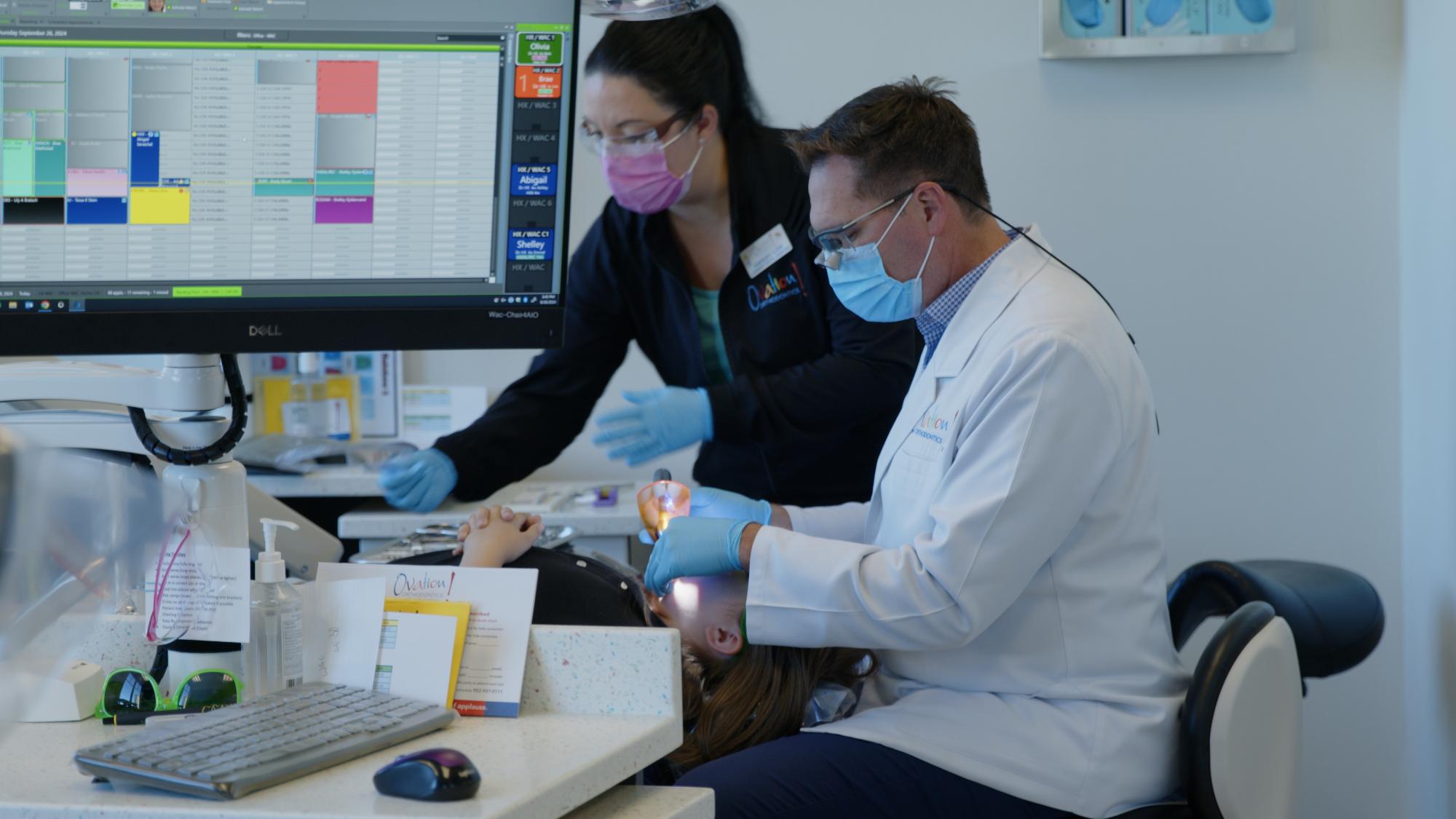
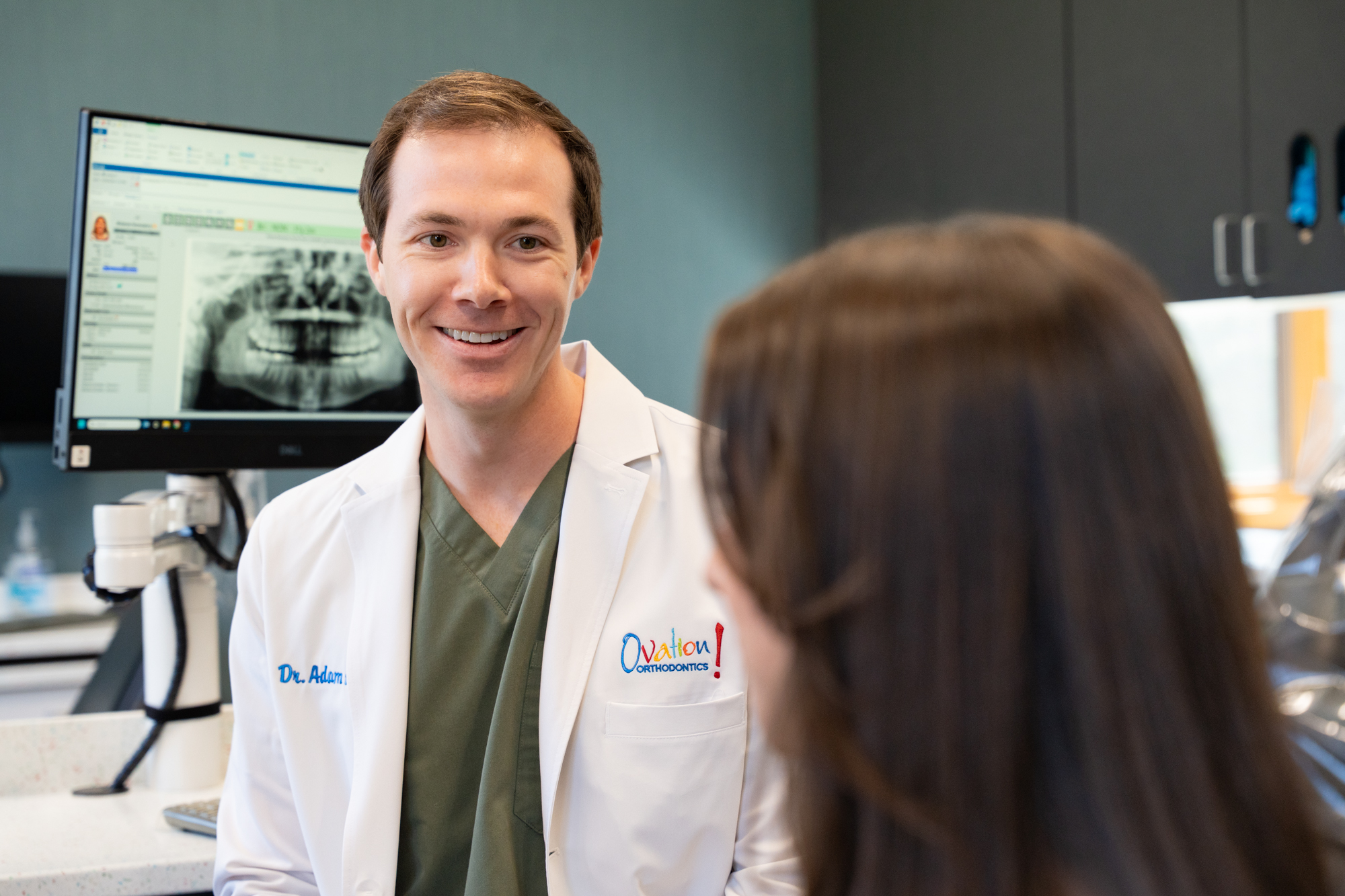
Dr. Adam Hoxie, DDS, orthodontist, Dr. Mike Hoxie, DDS, Dr. Mike Lee, DDS, and Dr. Tiffany Waki, DDS, treat all of these regularly. The plan looks different than it would for a 10-year-old, but the biology works the same way.
Braces as an Adult: How Treatment Works, Step by Step
Braces as an adult follow five steps: a free consult with exam and digital scans, a custom plan, placement day, progress visits every six to ten weeks, and retainers. Most adults finish in 12 to 24 months, depending on how far teeth and bite need to move.
Here’s what each step involves at Ovation Orthodontics.
What Happens at Your Free Consult?
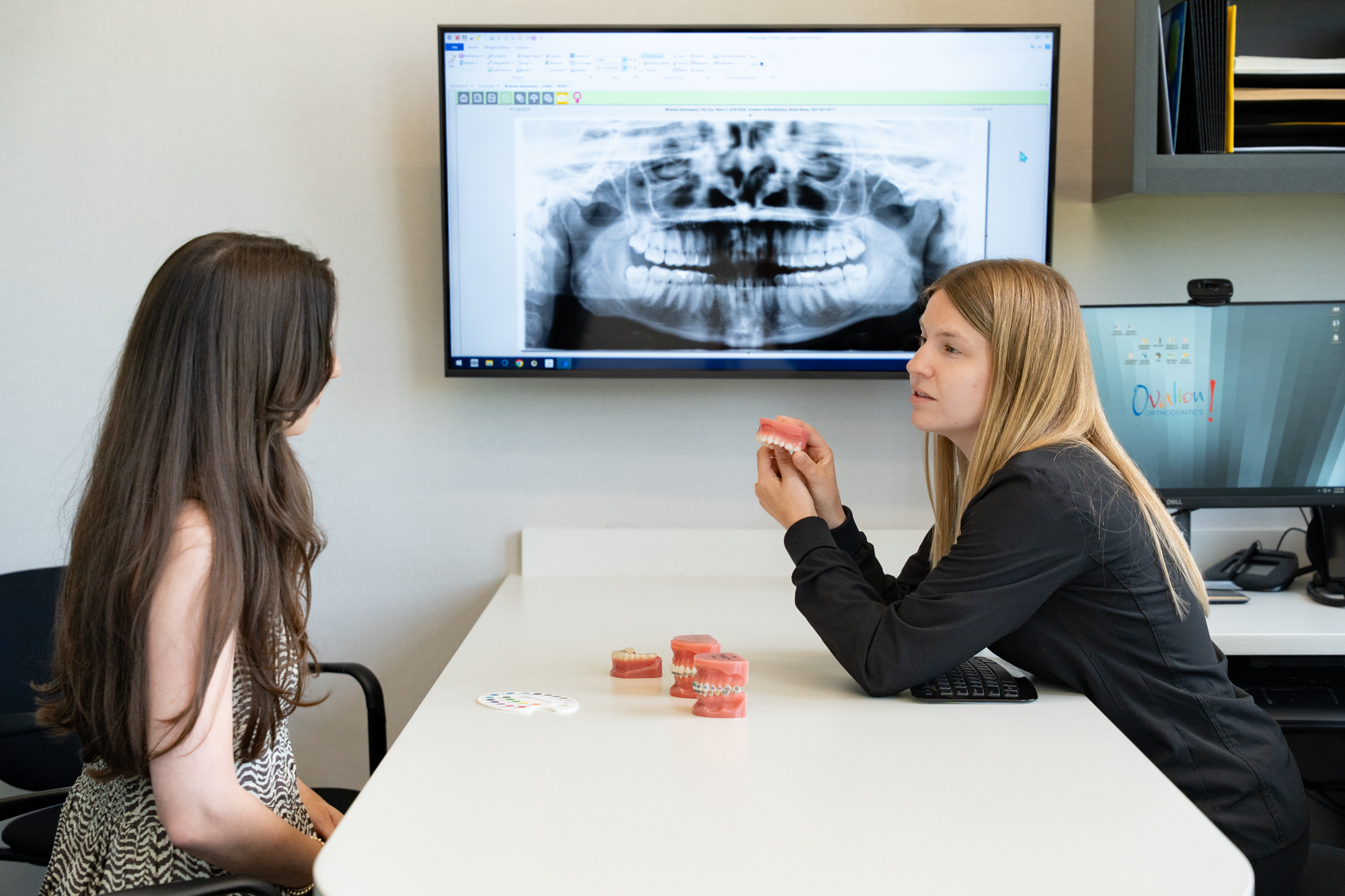
We examine your teeth, gums, and jaw, then take fast digital scans and X-rays. No messy impression trays. The scan maps tooth position, and the X-rays show root angles and bone support, which matters more in adult cases than in growing kids.
How Is Your Custom Plan Built?
Your doctor walks you through your smile solutions, an estimated timeline, and exact costs. You’ll see what’s realistic and what tradeoffs come with each option. Questions are welcome here. Most people have several, and we’d rather answer all of them now than have you wondering halfway through.
What Is Placement Day Like?
Brackets get bonded to the front of your teeth, or you go home with your first set of aligner trays. Expect roughly an hour. Teeth feel tender for a few days afterward, then settle.
How Often Are Progress Visits?
Every six to ten weeks, we adjust wires, change elastics, or hand off your next aligner sets. These visits are short. We keep our schedule tight so you’re not sitting in a waiting room on your lunch break.
Why Do Retainers Matter After Treatment?
Once teeth land where they should, retainers hold them there. Some adults get a thin fixed wire behind the lower front teeth, some get removable retainers, many get both. This step is permanent maintenance, not an optional add-on.
If you have crowns, older restorations, or gum concerns, we coordinate directly with your general dentist or periodontist. Sequencing matters. Gum therapy and needed fillings come first, then orthodontics, then any final restorative work once teeth are in position.
Why Do Adults Choose Braces?
Adults choose braces to make daily cleaning easier, to balance a bite that wears teeth unevenly, to prepare for a crown or implant, and to fix crowding that crept back after teen braces. Appearance matters too, and that’s a perfectly good reason on its own.
What Health Benefits Come with Straighter Teeth?
- Easier cleaning. Crowded, overlapping teeth trap plaque in spots floss can’t reach well. Aligned teeth are simpler to brush and floss, which supports gum health and lowers decay risk over time.
- Better bite function. When teeth meet evenly, chewing forces spread out. Uneven contact wears enamel down, chips edges, and can strain jaw muscles.
- Restorative prep. Tipped or drifted teeth leave awkward gaps. Moving them into proper position gives your dentist room to place a crown, bridge, or implant that fits and lasts.
Why Do Adults Get Braces a Second Time?
- Fixing relapse. Plenty of adults had braces as teens, stopped wearing retainers at some point, and watched the lower front teeth crowd back in. Retreatment is often shorter than the original round.
- Smiling freely in meetings and photos. Clear braces and Invisalign let most adults finish treatment without anyone really noticing.
Put simply: the mouth you keep clean is the mouth you keep. Alignment makes that daily job easier.
Braces at Every Age: How Treatment Differs from Kids to Adults
Age doesn’t decide whether teeth can move. It decides what tools are on the table. Growth gives orthodontists a way to guide jaw size and shape, and that window closes in the late teens. After that, we work with the skeleton you have.
| Age Range | What’s Happening | Typical Smile Solutions |
|---|---|---|
| 7-11 | Jaws still growing, mix of baby and permanent teeth | Early treatment, palate expanders, partial braces, Invisalign First to create space and often avoid extractions |
| 12-17 | Most permanent teeth in place, growth still active | Metal braces, clear braces, Invisalign Teen, elastics for bite correction |
| 18-39 | Bone mature, jaw shape set | Metal braces, clear braces, Invisalign; bite corrected through tooth position rather than growth |
| 40+ | Gum health and existing dental history drive the plan | Same smile solutions, with closer attention to periodontal support and coordination around crowns or implants |
A few honest differences for adults:
- Timelines can run slightly longer. Mature bone remodels more slowly than a growing teenager’s.
- Gum health takes center stage. Teeth move through bone, and bone needs healthy gums above it. We monitor this closely and may loop in a periodontist.
- Skeletal bite issues need a different approach. When the jaws themselves are mismatched, we either camouflage the bite by repositioning teeth or, in more significant cases, pair orthodontics with surgical orthodontics for balanced function.
The American Association of Orthodontists recommends a first orthodontic check by age seven, which is why kids can sometimes avoid extractions that an adult with the same crowding would need. That’s a real advantage of early care, not a reason for adults to skip treatment.
What Affects the Cost and Length of Adult Treatment
Adult treatment cost and length depend on four things: how much your teeth and bite need to move, which option you choose, whether any prep care is needed first, and your insurance benefits. Simple cases can wrap up in about six months, while full bite correction may run 24 to 30 months.
| Factor | Effect on Cost and Timeline |
|---|---|
| Case complexity | Mild front-tooth crowding costs less and finishes faster than full bite correction |
| Appliance type | Metal braces, clear braces, and Invisalign each carry different price points |
| Prep care needed | Fillings, gum therapy, or extractions add weeks before braces or aligners go on |
| Retention | Retainers and follow-up are part of the total, not a surprise later |
| Insurance and benefits | Orthodontic coverage, FSA, and HSA dollars lower what you pay out of pocket |
Cost varies by case, so a single posted number wouldn’t tell you much. What we can promise is that the number you hear at your free consult is the number you’ll pay, retainers and follow-up visits included.
Our team gives you exact figures at your free consult, before anything starts. Financing includes low monthly payments and 0% interest, and we help you sort out insurance paperwork instead of handing you a form and wishing you luck.
Are You a Candidate for Adult Braces or Invisalign?
Most adults are. Candidacy comes down to the condition of your gums and bone, not your age. Here’s what our doctors look for.
Good signs you’re ready:
- Healthy gums with no active infection
- Adequate bone support around the roots
- Decay treated and under control
- Willingness to wear aligners 20 to 22 hours a day, if that’s the route you choose
Things that usually aren’t dealbreakers:
- Crowns, bridges, or veneers. Brackets bond to these surfaces using an adjusted method. Aligners fit comfortably around them as well.
- Missing teeth. Space can be opened, closed, or held for a future implant.
- Past extractions or prior braces. Retreatment is common.
Things we address first:
- Active gum disease. This gets treated and stabilized before any braces or aligners go on. Moving teeth through inflamed tissue isn’t safe.
- Untreated decay or a tooth needing a root canal.
One detail worth knowing: dental implants fuse to bone and don’t move. Instead of fighting that, we design around them and often use them as anchors that help move neighboring teeth.
A visit with full records is the only reliable way to confirm candidacy. Photos on a phone can’t show root position or bone levels. The free consult at Ovation Orthodontics comes with no obligation and no referral needed, and Dr. Mike Lee, DDS, orthodontist, or any of our doctors will look at your teeth, take digital scans, and give you a straight answer about what treatment would involve, how long it would take, and what it would cost. Whenever you’re ready, welcome to the Ovation family.
Frequently Asked Questions About Adult Braces
Am I too old for braces at 40, 50, or 60?
No. There’s no upper age limit for orthodontic treatment. As long as your teeth and gums are healthy and your bone provides good support, teeth will move. Our doctors treat adults in every decade, and some of our most enthusiastic families are people who waited 30 years to finally do this.
How long do adult braces take compared to kids?
Often about the same, sometimes a few months longer. Mature bone remodels at a steadier pace, and adult cases can involve existing restorations that require careful sequencing. Simple alignment cases may finish in six to twelve months. Full bite correction generally runs 18 to 30 months.
Do braces hurt more as an adult?
No. Soreness is comparable to what teens experience, and it typically eases within about a week as your teeth adjust. Modern heat-activated wires apply gentle, continuous pressure rather than heavy force. Most adults describe the first few days as tenderness when biting, not much more.
Can I get Invisalign instead of braces as an adult?
Many adult cases qualify. Invisalign handles crowding, spacing, and a range of bite corrections using clear trays you remove for meals and brushing. Some situations, like significant rotations or large bite discrepancies, respond better to braces. Your doctor will tell you straight which option fits your case.
Will my teeth shift again after treatment?
They will if you stop wearing retainers. Teeth naturally drift throughout life, which is exactly why so many adults return for a second round after their teen braces. Retainer wear is what makes a straight smile last. We’ll set you up with a routine that’s easy to stick with.
Can I get braces if I have crowns or implants?
Usually yes. Brackets bond to crowns and veneers with an adjusted bonding method, and aligners work smoothly around restorations. Implants stay put since they’re fused to bone, so we plan around them, often using them as stable anchor points. Your treatment design accounts for all of it from day one.